

An award-winning director of music videos, screenwriting, commercials and films, Michel Gondry is celebrated for manipulation of visual elements and innovative staging effects (IvyPand, 2021). His imaginative realm exists between the state of unconscious and conscious, defying any realistic senses (Hirschberg, 2006).
Gondry conceptualises pop-music with an intuitive commodity of unique and colourful dream-world imagery. Pop music structure instigates Gondry’s sensitivity, strengthening his imaginative world, inspiring experimental creativity, to capture and mirror its repetitive rhythm. It becomes predominant within Gondry’s music video, “Let Forever Be”, directing the viewer through layers of staging effects, hybrid cyclical and linear kaleidoscopic imagery (Goldsmith, 2004).
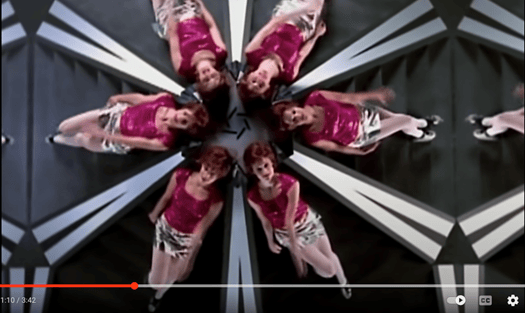
Digital editing allows innovative processing techniques, experimentation between the dancer and camera, with the possibilities to fuse, duplicate and dissolve the performers. To further investigate this notion in “Let Forever Be”, Gondry employs dissolving the dancer’s shot, transforming her image looking into a mirror, to speeding up the escalator at a shopping mall. At (Let Forever Be 1:10), the linear motion image flattened and duplicated six times into a mechanical form of a kaleidoscope, a cyclical aerial composition (Tsai, 2016).
| Figure 1 The Chemical Brothers – Let Forever Be (Official Music Video) |
Gondry employs innovative kaleidoscopic staging techniques, creating an illusive space occupying the dancer’s identical image (Buckland, 2018). However, it is evident that such techniques are shared by Berkeley, with his dynamic “birds-eye shots of chorus girls arranged in concentric circles” (Rubin, 1993, p. 72), and the mesmerising bodily compositions (Tsai, 2016). Traditionally, such techniques could be considered as novice, initiated by the early pioneers such as Berkeley (IvyPand, 2021).
Figure 2
Beautiful Girls – Dames, Warner Archive
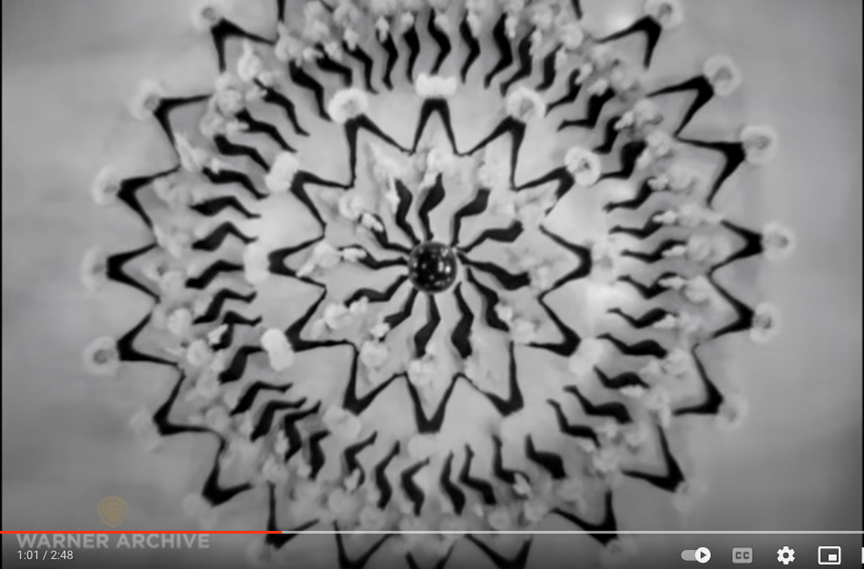
Note: Abeautiful pattern by Berkely showing the overhead arrangement and the flow effect of his kaleidoscope. This fountain like pattern describes Berkely’s style and his contribution to manipulate an emotional stunning overhead shot.From “Beautiful Girls – Dames, Warner Archive”, by Warner Archive, 2017 (https://www.youtube.com/watch?v=9bVJol3-XLo)
To further identify this common vision, Berkeley’s “form constraint gravity” (Rubin, 1993, p. 72), aiming to turn the aerial shots of the chorus “limbs and torsos” (Rubin, 1993, p. 72) into “a kaleidoscope of art deco patterns” (Mackrell, 2017). Gondry expands on this effect by architecting an artificial simulator, a kaleidoscopic pattern reflecting the state of human individualism and mirroring the trap between daily life duties and how to fulfil our dreams (Tsai, 2016). In “Demas”, Berkeley’s ‘Zigzag fashion’ (Rubin, 1993, p. 73) replicates a manufactured interaction between camera and dancer, mirroring the assembly order found in a production line.
Alternatively, Gondry employs the digital era, enhancing this interaction, as camera lens becomes the electronic eye of surveillance (Tsai, 2016). Rubin (1993) stated that Berkeley’s “kaleidoscopic effects are evidently unique to the cinema” (P. 72). Similarly, Gondry’s aesthetic purpose retains technology, and “Let Forever Be” hybridises film collaging, staging effects and video, offering a unique dreamlike world that contributes to alter the pace of music video production (Tsai, 2016).
Reference List:
Images
The Chemical Brothers. (2009). The Chemical Brothers – Let Forever Be (Official Music Video) (1:10) [Screenshot]. YouTube. Retrieved August 16, 2022, from https://www.youtube.com/watch?v=s5FyfQDO5g0
Warner Archive. (2017). Beautiful Girls – Dames, Warner Archive (1:01) [Screenshot]. YouTube. Retrieved August 13, 2022, from https://www.youtube.com/watch?v=9bVJol3-XLo
Articles from the Web
IvyPanda. (2021). Michel Gondry as a Contemporary Filmmaker, Retrieved August 11, 2022, from https://ivypanda.com/essays/michel-gondry-as-a-contemporary-filmmaker/
Hirschberg, L. (2006). Le Romantique. The New York Times, Retrieved August 11, 2022, from http://web.archive.org/web/20130521021058/www.nytimes.com/2006/09/17/magazine/17gondry.html?pagewanted=1&_r=1
Goldsmith, L. (2004). The Work of Director Michel Gondry. Retrieved August 11, 2022, from http://notcoming.com/features/gondry/
Tsai, A. (2016). Hybrid texts, assembled bodies: Michel Gondry’s merging of camera and dancer in “Let forever be”. The International Journal of Screendance, 6. Retrieved August 11, 2022, from https://screendancejournal.org/article/view/4892/4231#fn26
Mackrell, J. (2017). A kaleidoscope of legs: Busby Berkeley’s flamboyant dance fantasies. The Guardian, Retrieved August 13, 2022, from https://www.theguardian.com/stage/2017/mar/23/busby-berkeley-dance-42nd-street-choreography-film-musicals
Buckland, W. (2018). The Unnatural and Impossible Storyworlds of Michel Gondry’s Music Videos: The Mise en Abyme of ‘Bachelorette’. Open Edition Journals, Retrieved August 13, 2022, from https://journals.openedition.org/volume/5689?lang=en
Books
Rubin, M. (1993). Broadway before Berkeley. In Showstoppers: Busby Berkeley and the Tradition of the Spectacle (pp. 59–81). New York: Columbia University Press. https://commons.swinburne.edu.au/file/ca68f3a0-1cfd-4df3-bccc-2e71c383ee12/1/1012546.pdf